

Animation's AI rules are getting clearer: what Manchester's festival ban, SAG-AFTRA's voice deal and studio policies mean for brand video
17 November 2026
Current news (as of 17 November 2026)
The rules are being written in public
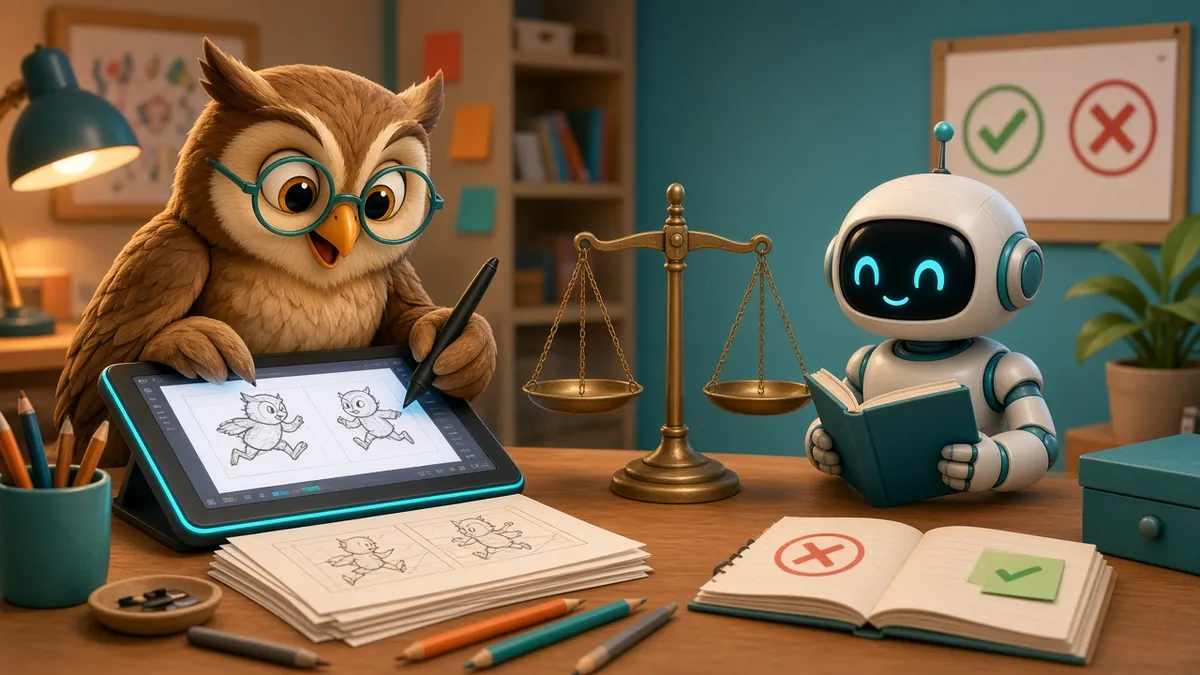
For most of the last two years, the AI conversation in animation was about what the tools could do. This month, more of the news is about rules: who may use generative AI, where, and with whose permission. Three developments stand out.
- Manchester Animation Festival (MAF), the UK's only Oscar- and BAFTA-qualifying animation festival, said it will not accept films made with generative AI from its 2027 competition onwards.
- SAG-AFTRA members ratified new US television animation contracts that require a voice actor's consent before a digital replica of their voice is used to dub a performance into another language.
- Studios are taking openly different positions. At Taiwan Creative Content Fest, Weta FX announced an AI hub partnership, Toei described using generative AI for backgrounds, and Blue Spirit said it is barred from using AI on its Netflix work.
None of this bans AI from commercial work, but "was AI used, and how?" is becoming a normal question for brands commissioning animation.
Manchester draws a line between "generated animation" and generative AI
MAF announced the policy alongside its 2026 winners. Its published policy is more detailed than a simple ban, and the distinction it makes is useful for anyone planning a production.
The policy separates two things:
- Generated animation: using a computer to complete motion, such as coded crowd scenes, hair simulation, colouring multiple frames or motion tweening between keyframes. This stays eligible, as long as the artist is in control of the input and the outcome.
- Generative AI: work where a model takes a prompt and calculates an approximation of what was asked for. Under the policy, if any part of the final moving image has been generated or transformed by a generative audio, image or video model, the film is ineligible.
The festival may ask for evidence that a film complies, and lists August 2027 as its next policy review date.
Interestingly, MAF's awards include a Commissioned Film category. This year it went to Kikkoman: Unleash Legendary, directed by Mariano Fernández Russo of Clubcamping. Brand-funded animation competes at festivals like this, so the new rule applies to commissioned work too.
Voice actors now control AI dubbing
On 29 October, SAG-AFTRA members ratified the 2026 Television Animation Agreement and the 2026 Basic Cable Animation Agreement, Voice Over Herald reported, with close to 95% of voting members in favour. The four-year deal runs from 1 July 2026 to 30 June 2030.
The AI terms, as set out in the union's summary of the agreement, include:
- Consent for foreign-language dubbing. The previous contract allowed producers to use a voice actor's digital replica to render a performance into another language without consent. That is reversed for productions commencing principal photography on or after 1 July 2027.
- "No scan" replicas are protected. A replica built from ordinary recording sessions still counts as an employment-based digital replica, with the same protections.
- Pay for independently created replicas. If a producer uses a replica the actor created independently, the minimum payment is the session fee, with residuals where a human performance would qualify.
- Security and transfer rules. Producers must limit access to replicas and remain responsible for compliance if they transfer one to another party.
This contract covers US union television animation, not Indian brand films. But it sets a clear benchmark for how voice cloning and AI dubbing are being treated, and multilingual versions are one of the most common requests in brand and explainer video.
Studios are choosing different paths
Variety's report from Taiwan Creative Content Fest shows how far apart studio positions are. Weta FX CEO Daniel Seah said studio legal departments had ruled out generative AI on their projects early last year, but that clients have since been asking about Weta's AI strategy, mostly to find out how much money it could save. Weta FX signed a memorandum of understanding with the Taiwan Creative Content Agency on 6 November and will partner with Moonshine Studio.
Toei president Yoshimura Fumio said the studio has adopted rules for generative AI and already uses it for backgrounds. On the same AI panel, Blue Spirit's chief creative officer Charles Beirnaert said the studio is barred from using AI on its Netflix work.
The answer depends on the client, the distributor and the contract, not just on the software.
What to put in your next animation brief
For brands, the practical step is to decide your AI position before production starts, rather than discovering it at delivery. A short section in the brief can cover:
- Where AI is allowed. For example: allowed for internal ideation and storyboard drafts, not allowed in final frames. Or allowed for backgrounds, not for characters.
- Voice and dubbing. Will you use human voice artists for every language, or AI dubbing? If AI, confirm written consent from the original voice artist for that use.
- Distribution and festivals. If the film may be entered for awards, check the rules of each festival you have in mind. MAF, for one, now excludes any generative AI in the final image.
- Platform labels. Some platforms require disclosure of realistic AI-generated content, so record what was used and where.
- Ownership and records. Ask your studio to log which tools were used on which shots.
The short version
Generative AI is not disappearing from animation, but the industry is separating artist-controlled tools from generated final images, and treating voices as something that needs consent. A clear AI clause in your brief costs little, and it avoids surprises when the film is finished.
Sources
- Animation World Network, "Manchester Animation Festival Names 2026 Winners, Bans Gen AI Entries" (16 November 2026)
- Manchester Animation Festival, "Generative A.I Policy for Filmmakers" (reviewed November 2026)
- Voice Over Herald, "SAG-AFTRA Voice Actors Ratify the TV Animation Deal. Your AI Replica Now Needs Your Yes to Dub You" (29 October 2026)
- SAG-AFTRA, "Television Animation Agreements" summary of the tentative agreement
- Variety, "Taiwan Creative Content Fest Takeaways: AI Deals, Character IP Boom" (11 November 2026)